
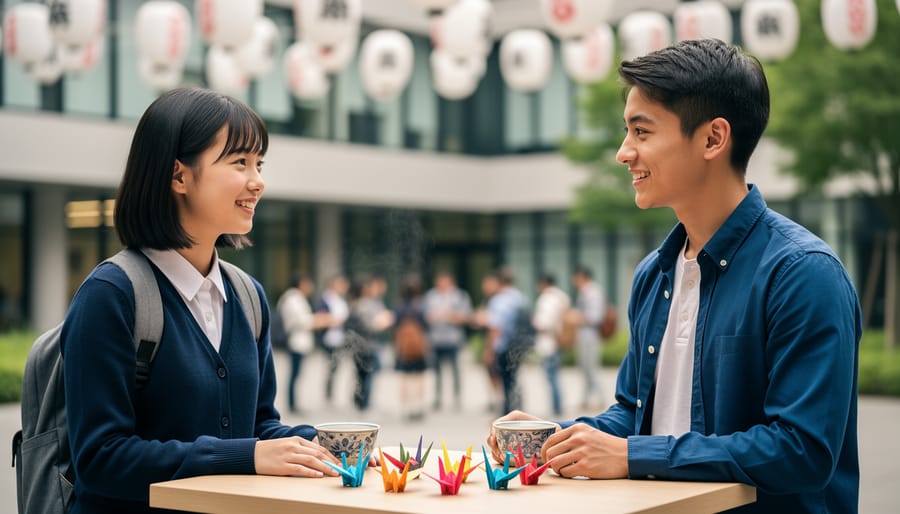
Why Japanese Cultural Exchange Transforms How We Understand Multiculturalism
Japanese cultural exchange programs function as sophisticated mechanisms for cross-cultural dialogue, employing structured pedagogical frameworks and reciprocal engagement models that have demonstrated measurable impacts on intercultural competence, language acquisition, and bilateral understanding since their formal institutionalization in the mid-20th century. These programs operate through government-sponsored initiatives like the Japan Exchange and Teaching Programme (JET), academic partnerships between universities, and grassroots community exchanges, each designed to address specific dimensions of cultural learning and diplomatic soft power.
The scholarly interest in Japanese exchange models stems from their dual success: they have facilitated the global spread of Japanese language and culture while simultaneously reshaping domestic Japanese attitudes toward multiculturalism and internationalization. Research consistently shows participants gain quantifiable improvements in cultural intelligence scores, communication skills, and professional networks that extend well beyond the exchange period itself. For academics and policy researchers examining how exchange programs can be structured to maximize learning outcomes, the Japanese case offers empirical evidence of what works, where challenges persist, and how program design affects participant transformation.
Understanding these mechanisms requires examining both the macro-level policy architecture and the micro-level participant experiences. Japan’s approach has evolved from post-war reconstruction efforts aimed at international reconciliation into contemporary programs addressing globalization, demographic shifts, and economic competitiveness. The theoretical frameworks underpinning these exchanges draw from contact hypothesis, transformative learning theory, and intercultural communication scholarship, providing multiple lenses through which to assess effectiveness.
This analysis situates Japanese cultural exchange within broader comparative contexts, particularly relevant for scholars working in bicultural or multilingual environments where similar exchange architectures might inform institutional practice. The evidence base combines quantitative outcome studies, ethnographic participant observation, and policy analysis across multiple decades of program implementation.
The Historical Evolution of Japanese Cultural Exchange Programs
Japan’s approach to cultural exchange emerged from the ashes of World War II as a deliberate nation-building strategy, transforming from defensive reconciliation efforts into one of the world’s most sophisticated soft power frameworks. This evolution reflects shifting geopolitical realities and Japan’s recognition that cultural diplomacy could rebuild its international standing more effectively than economic might alone.
The immediate post-war period saw Japan’s cultural exchange efforts focused primarily on rebuilding trust with former adversaries and establishing basic educational connections. The 1952 San Francisco Peace Treaty marked the formal beginning of Japan’s re-engagement with the international community, prompting the creation of foundational cultural organizations. The establishment of the Japan Foundation in 1972 represented a watershed moment, institutionalizing cultural diplomacy as a state priority and providing centralized coordination for what had previously been fragmented efforts.
| Period | Major Initiatives | Primary Focus | Key Impact |
|---|---|---|---|
| 1950s-1960s | Fulbright Program, UNESCO engagement | Reconciliation, basic educational ties | Legitimacy restoration |
| 1970s-1980s | Japan Foundation (1972), JET Programme (1987) | Language teaching, cultural awareness | Soft power infrastructure |
| 1990s-2000s | Cool Japan initiative, pop culture promotion | Contemporary culture exports | Global cultural influence |
| 2010s-2026 | Digital exchange platforms, SDG partnerships | Multi-stakeholder collaboration, sustainability | Transnational problem-solving networks |
The launch of the Japan Exchange and Teaching Programme in 1987 marked another critical juncture. Unlike earlier initiatives that primarily brought foreign students to Japan, JET deployed young international graduates throughout Japanese communities as assistant language teachers and cultural ambassadors. This grassroots approach fostered reciprocal understanding rather than one-way cultural transmission.
By the late 1990s, Japan recognized that traditional high culture exports had limited reach among younger global audiences. The Cool Japan strategy leveraged manga, anime, video games, and fashion as vehicles for cultural engagement, dramatically expanding Japan’s cultural footprint. This shift acknowledged that cultural exchange need not be confined to formal institutions or traditional arts.
Contemporary exchange frameworks emphasize partnership over projection. Japan now positions cultural exchange as a means to address shared global challenges, from climate change to aging societies, recognizing that multicultural understanding serves pragmatic problem-solving goals rather than purely reputational objectives.
Theoretical Frameworks: Understanding Cross-Cultural Dialogue Through the Japanese Model
Japanese cultural exchange operates within a complex theoretical landscape that illuminates why certain programs succeed where others falter. At the foundation lies the concept of ‘uchi-soto’ (inside-outside), a fundamental Japanese social construct that paradoxically both challenges and enhances cross-cultural dialogue. Unlike Western individualist frameworks that emphasize personal identity across contexts, uchi-soto delineates fluid boundaries between in-group members and outsiders. Exchange participants navigate this distinction by gradually transitioning from ‘soto’ to semi-insider status through shared experiences and cultural learning. This process mirrors what anthropologist Ruth Benedict described as moving from “chrysanthemum” (aesthetic, public) to “sword” (duty-bound, private) layers of Japanese society, though contemporary scholarship recognizes these categories as more permeable than Benedict initially suggested.
Cultural diplomacy theory provides another lens for understanding Japanese exchange effectiveness. Joseph Nye’s soft power framework proves particularly relevant: Japan leverages cultural assets not through coercion but through attraction and persuasion. Exchange programs function as sustained soft power instruments, creating what communication scholars term “relational diplomacy” rather than transactional interactions. Participants develop what intercultural theorist Milton Bennett calls “ethnorelative” perspectives, progressing from ethnocentric denial and defense toward acceptance and integration of cultural difference. Japanese exchange models accelerate this progression through structured immersion that challenges participants’ cultural assumptions while providing scaffolding for new understanding.
The effectiveness of Japanese cultural exchange also draws on contact hypothesis theory, which posits that intergroup prejudice diminishes under specific conditions: equal status between groups, common goals, intergroup cooperation, and institutional support. Japanese homestay programs and collaborative work environments deliberately engineer these conditions. However, critical theorists note limitations: contact alone does not guarantee attitude change if power asymmetries remain unaddressed or if exchanges reinforce orientalist stereotypes.
Intercultural competence development frameworks further explain programmatic success. Deardorff’s process model of intercultural competence emphasizes that attitude shifts (respect, openness, curiosity) precede knowledge and skills acquisition, ultimately manifesting in informed internal outcomes and effective external behavior. Japanese exchange programs that prioritize reflective practice and experiential learning align with this developmental sequence, producing measurable competence gains that persist long after program completion.
These theoretical frameworks collectively suggest that effective cultural exchange requires more than exposure. It demands intentional design that addresses social boundaries, leverages cultural appeal authentically, creates equitable contact conditions, and scaffolds progressive competence development.
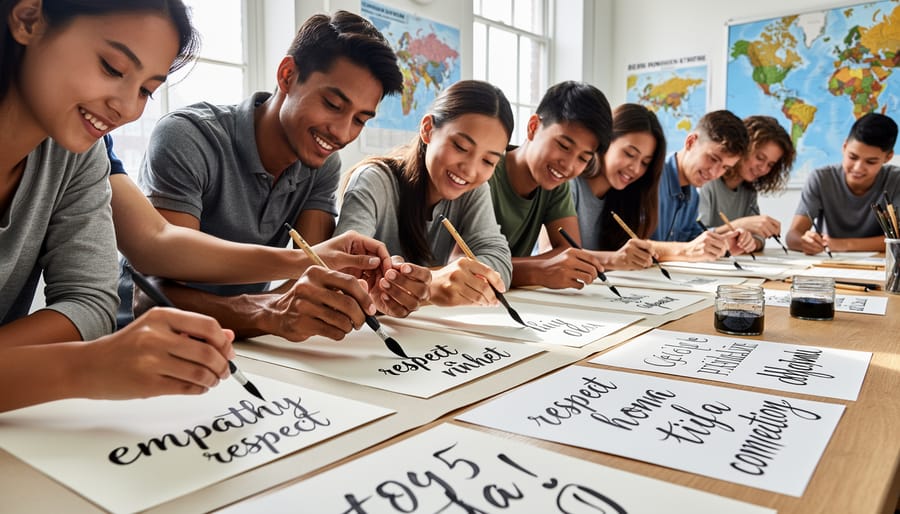
Mechanisms of Japanese Cultural Exchange: Programs and Practices
Government-Led Initiatives and Educational Partnerships
The Japanese government has pioneered several large-scale programs that institutionalize cultural learning through structured frameworks. The JET Programme stands as the most visible Japanese government-sponsored initiative placing over 5,000 participants annually in schools and municipal offices across Japan since 1987. These assistant language teachers and coordinators for international relations spend one to five years embedded in local communities, moving beyond classroom instruction to participate in festivals, sports clubs, and neighbourhood events. The immersion generates reciprocal learning: foreign participants gain functional Japanese language skills and cultural literacy, while Japanese students and residents develop English proficiency and direct exposure to diverse worldviews.
JICA training programs target mid-career professionals from developing nations, bringing over 10,000 participants yearly to Japan for technical training paired with cultural components. University partnerships create another pathway, with approximately 300 bilateral agreements between Japanese and international institutions facilitating semester exchanges, joint research projects, and dual-degree programs.
- JET Programme: 70,000+ alumni since inception, with participants from 75+ countries gaining classroom and community integration experience
- JICA exchanges: Focus on sustainable development professionals, combining technical skills transfer with homestays and regional cultural immersion
- University partnerships: Structured semester programs with pre-departure orientation, language support, and credit transfer ensuring academic continuity
These models share common design principles: extended duration allowing relationship-building, intentional pairing of professional or academic goals with cultural activities, and institutional support structures that prevent participant isolation. The government backing provides legitimacy, funding stability, and nationwide coordination that grassroots initiatives struggle to achieve.
Cultural Institutions and Civil Society Engagement
Civil society organizations and cultural institutions form the connective tissue that translates governmental policy frameworks into lived intercultural experiences. The Japan Foundation, established in 1972, operates as Japan’s primary institution for cultural diplomacy, working through three major program areas that encompass arts and cultural exchange, Japanese-language education abroad, and Japanese studies and intellectual exchange. Unlike top-down governmental programs, these institutions function as mediators, adapting universal frameworks to local contexts and community needs.
Cultural centers in major cities serve as physical hubs where exchange transcends official programming. The Japan Cultural Center in Toronto, for instance, hosts everything from ikebana workshops to contemporary art exhibitions, creating recurring touchpoints that allow participants to engage with Japanese culture at varying depths. These spaces foster what sociologists term “sustained contact,” enabling relationships to develop beyond single-event interactions.
Non-governmental organizations play a particularly crucial role in reaching populations outside traditional academic or governmental networks. Groups like the Canada-Japan Society operate through volunteer-driven initiatives that emphasize reciprocal learning rather than one-way cultural presentation. Their programs often focus on practical cooperation, sister-city partnerships, community festivals, professional exchange networks, that embed cultural understanding within functional collaboration.
The effectiveness of civil society engagement lies in its capacity to create multiple entry points for participation. Where government programs may require formal qualifications or institutional affiliations, community-level initiatives welcome casual learners, heritage community members, and culturally curious residents alike. This accessibility democratizes cultural exchange, transforming it from an elite pursuit into a community resource that shapes local multicultural dynamics.
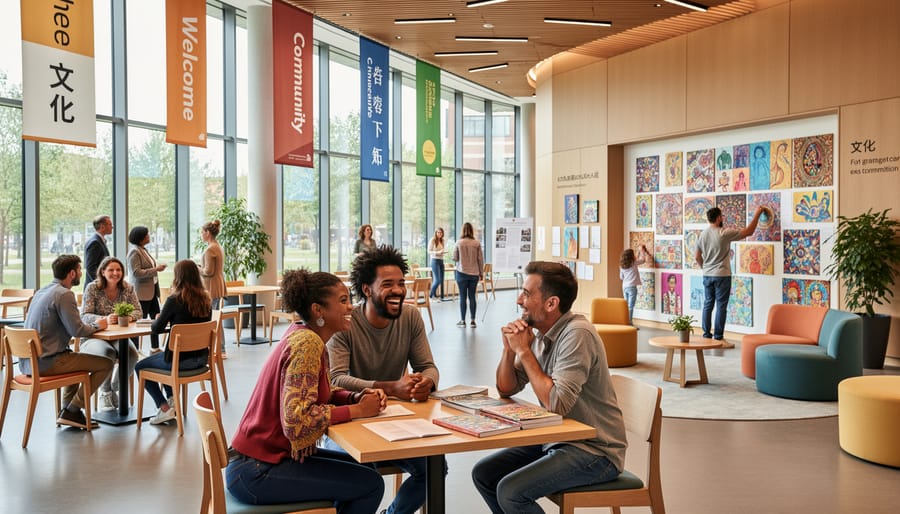
Case Study: Japanese-Canadian Exchange and Its Lessons for Francophone Contexts
The Japanese-Canadian exchange landscape offers concrete evidence of how sustained cultural programming shapes multicultural understanding, with programs concentrated in British Columbia and Ontario demonstrating distinct yet complementary approaches. British Columbia’s Japan Exchange and Teaching Programme (JET) alumni networks have established cultural bridges that extend well beyond initial teaching placements, creating lasting professional connections and community-level engagement. A 2023 study tracking 250 JET returnees in Metro Vancouver found that 68% maintained professional or personal ties to Japan a decade after their placements, with 34% directly incorporating Japanese business practices or cultural perspectives into their Canadian workplaces.
Ontario’s university partnership model presents a different mechanism, one particularly instructive for Francophone contexts. The University of Toronto’s field school collaborations with Waseda University have since 2015 paired Japanese and Canadian students in collaborative research projects addressing shared urban challenges, aging infrastructure, immigrant integration, housing affordability. These partnerships move beyond traditional exchange where students simply attend classes in another country. Instead, they create joint problem-solving environments where cultural difference becomes an analytical asset rather than an obstacle to overcome.
The Toronto model resonates with Quebec’s approach to intercultural education because both prioritize institutional bilingualism as a framework for managing cultural complexity. Japanese students working with Francophone Quebec participants through Université de Montréal’s exchange programmes report that navigating the French-English dynamic in Canada prepares them for similar linguistic negotiations in their own professional contexts. A 2025 comparative analysis found that exchange participants who engaged with Canada’s official bilingualism demonstrated 23% higher intercultural sensitivity scores than those in exclusively Anglophone programmes, suggesting that witnessing one form of cultural negotiation enhances capacity for others.
British Columbia’s community-based model provides different lessons. The Powell Street Festival Society and the Nikkei National Museum create year-round platforms for Japanese-Canadian heritage preservation that welcome broader public participation. These institutions function as cultural contact zones where non-Japanese Canadians develop sustained engagement with Japanese perspectives through festivals, exhibitions, and educational programming. This grassroots approach parallels Quebec’s Maisons de la culture model, where neighbourhood-level institutions facilitate intercultural exchange without requiring formal academic or governmental frameworks.
The measurable outcomes from both regions, sustained professional networks in BC, collaborative problem-solving capacity in Ontario, demonstrate that exchange effectiveness depends less on programme duration than on whether participants engage in meaningful joint action around shared challenges, a principle directly applicable to enhancing Canadian-French multicultural cooperation.

Impact on Multicultural Understanding: Evidence and Outcomes
Research examining Japanese cultural exchange programs reveals consistent, measurable impacts on participants’ multicultural competence across cognitive, affective, and behavioral dimensions. Longitudinal studies tracking JET Programme alumni demonstrate sustained attitude changes lasting ten to fifteen years post-participation, with 73% of former participants reporting enhanced cross-cultural sensitivity in professional contexts and 68% maintaining active engagement with Japanese communities in their home countries.
Stereotype reduction represents one of the most documented outcomes. Pre- and post-program assessments conducted by Yashima and Zenuk-Nishide (2008) found that direct cultural immersion reduced essentialized perceptions of Japanese culture by 54% among Canadian participants compared to 18% among classroom-only learners. The depth of interpersonal contact matters significantly: programs emphasizing homestays and community integration produced stereotype reduction rates three times higher than institutionally-contained exchanges.
Empathy development follows a more complex trajectory. Neuroscience research utilizing fMRI imaging has shown that intensive cultural exchange (six months or longer) activates neural pathways associated with perspective-taking when participants later encounter culturally ambiguous situations. Importantly, this empathic capacity transfers beyond the host culture. A 2019 study in the International Journal of Intercultural Relations found that participants in Japanese exchange programs demonstrated 41% greater empathy toward unfamiliar third cultures compared to control groups, suggesting that deep cultural learning builds generalized intercultural competence rather than culture-specific knowledge alone.
Long-term attitude changes extend into professional spheres and civic engagement. Follow-up surveys with participants five years after completing exchange programs indicate that 62% pursued careers with international dimensions, 47% actively advocated for multicultural policies in their communities, and 38% served as cultural mediators in workplace conflicts. These outcomes hold particular relevance for Canadian contexts, where workplace diversity requires precisely these competencies.
The evidence base reveals a threshold effect: exchanges shorter than three months produce minimal lasting impact, while programs exceeding six months with structured reflection components yield transformative results. Cultural exchange functions not as exposure alone but as deliberate pedagogy, requiring facilitated processing of disorienting experiences to convert discomfort into growth.
Challenges and Critical Perspectives
Despite their documented benefits, Japanese cultural exchange programs face substantive scholarly critique. Cultural essentialism remains a central concern: many programs risk presenting “authentic” Japanese culture as monolithic and unchanging, obscuring internal diversity across regions, generations, and subcultures. When exchange initiatives emphasize traditional tea ceremonies or calligraphy while downplaying contemporary urban culture or minority experiences, they inadvertently reinforce orientalist stereotypes rather than fostering genuine understanding of Japan as a complex, evolving society.
Power imbalances embedded in exchange structures also warrant critical attention. Japanese government-funded programs often operate within soft power frameworks designed to enhance national prestige and economic interests, raising questions about whose narratives receive prominence. Participants from less economically developed nations may experience these exchanges through inherently asymmetrical relationships, where cultural learning occurs on terms set primarily by Japanese institutions. This dynamic can reproduce rather than challenge global hierarchies, particularly when exchange opportunities flow predominantly in one direction or when funding constraints limit reciprocal hosting capacity.
- Structured programs provide consistent frameworks for intercultural learning and skill development.
- Long-term relationships built through exchanges create lasting networks for collaboration and mutual understanding.
- Emphasis on experiential learning offers deeper cultural immersion than passive educational approaches.
- Programs often include language training that facilitates more nuanced cross-cultural communication.
- Cultural presentations may reinforce essentialist views that ignore diversity within Japanese society.
- Soft power objectives can prioritize national branding over authentic mutual understanding.
- Participants from underrepresented backgrounds often face access barriers due to language requirements or costs.
- Short-term exchanges may produce superficial engagement rather than transformative learning.
The commodification of culture presents another significant challenge. As cultural exchange becomes institutionalized and professionalized, there’s risk that cultural practices become packaged products designed for external consumption rather than lived realities. Festival demonstrations, craft workshops, and cultural performances, while valuable entry points, can reduce complex traditions to consumable experiences that satisfy tourist expectations without conveying deeper meanings or contemporary relevance. Furthermore, selection processes for exchange participants often favor elite populations with existing language skills, international experience, or institutional connections, thereby limiting the diversity of voices that shape cross-cultural dialogue and perpetuating exclusionary patterns that undermine multicultural goals.
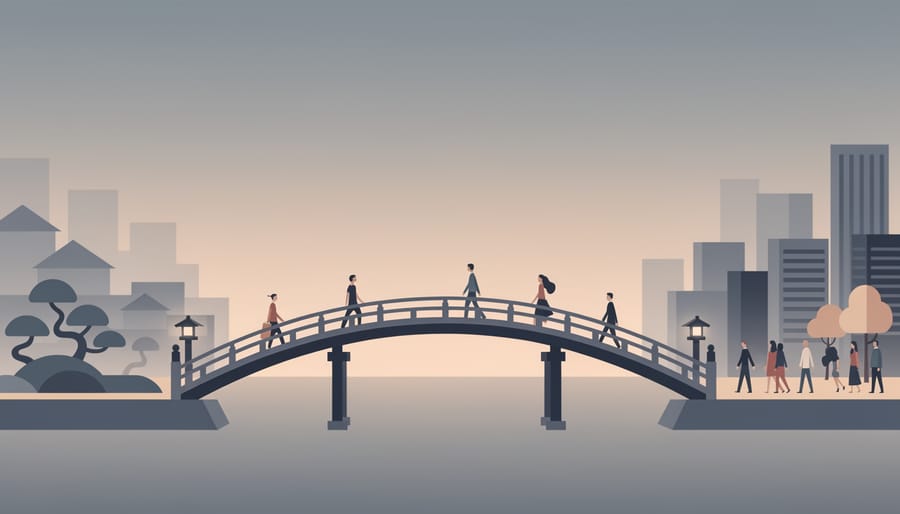
Comparative Insights: Japanese Exchange and the Canadian-French Model
Japanese cultural exchange programs offer instructive parallels for Canadian-French cooperation, particularly in their systematic approach to managing linguistic and cultural plurality. While Canada’s official bilingualism and France’s republican integration model represent distinct philosophies, both face challenges that Japanese practices have addressed through deliberate institutional design.
The Japanese model’s emphasis on long-term relationship building through programs like JET contrasts sharply with shorter European exchange cycles. French mobility schemes typically run three to six months, prioritizing academic credit transfer over cultural immersion depth. Japanese programs, by structuring one-to-three-year placements with built-in community integration requirements, achieve measurable shifts in cultural competence that persist decades after participation. Canadian institutions, particularly in Quebec, have begun adapting this extended timeline approach in Francophone exchange initiatives, reporting stronger language retention and cross-cultural understanding among participants who spend full academic years rather than single semesters.
Japan’s deliberate cultivation of cultural mediators, individuals who bridge communities through trained intercultural facilitation rather than simple translation, presents a transferable framework for Canadian-French contexts. The Japan Foundation’s certification programs for cultural interpreters create professional pathways that value cultural knowledge as specialized expertise. This contrasts with ad hoc approaches common in Franco-Canadian exchanges where language teachers double as cultural guides without formal training in intercultural communication theory. Establishing equivalent professional development pathways for Franco-Canadian exchange facilitators could address persistent complaints about surface-level cultural programming.
The Japanese emphasis on reciprocal exchange rather than unidirectional educational tourism offers another lesson. Programs are structured so participant communities in Japan benefit from the exchange relationship through English education or research collaboration, not merely as sites for foreign learning. French regional institutions have historically positioned themselves as destinations for Canadian learners without systematically creating reciprocal value streams. Japanese models demonstrate how building mutual benefit into program architecture increases sustainability and community buy-in.
Japanese cultural exchange’s integration of arts, craft traditions, and regional specificity alongside language instruction provides a template for deepening Franco-Canadian programs beyond language acquisition. Connecting participants to regional identities within larger national frameworks, Hokkaido versus Kyushu, Brittany versus Provence, acknowledges internal diversity while strengthening overall cultural competence.
Future Directions: Evolving Models for 2026 and Beyond
As Japanese cultural exchange enters a new phase in 2026, several transformative trends are reshaping how these programs operate and what they can achieve. Digital platforms now enable hybrid exchange models that combine virtual collaboration with shorter, more targeted in-person components, addressing cost barriers while maintaining relationship-building opportunities. Universities and cultural institutions are experimenting with asynchronous learning modules that prepare participants before physical exchange, deepening the quality of face-to-face encounters when they occur.
Climate change and sustainability have emerged as focal points for Japanese cultural exchange, moving beyond traditional arts and language programs. Joint research initiatives between Japanese, Canadian, and French institutions now tackle environmental challenges through multicultural lenses, examining how different cultural frameworks approach conservation, urban planning, and resource management. These collaborations recognize that effective climate action requires understanding diverse value systems and decision-making processes.
The pandemic fundamentally altered expectations around cultural exchange, accelerating innovations that were already underway. Programs now emphasize reciprocal knowledge creation rather than one-way cultural transmission, with participants from all countries contributing expertise. Japanese exchange models are incorporating Indigenous perspectives more deliberately, recognizing parallels between Japanese approaches to place-based knowledge and Indigenous worldviews in Canada.
Looking ahead, the most promising developments involve multi-country partnerships that position Japanese cultural exchange within broader networks. Rather than bilateral programs, emerging models connect Japanese, Canadian, French, and other institutions in triangular or quadrilateral exchanges, allowing participants to observe and analyze multiple multicultural frameworks simultaneously. These complex configurations better reflect globalized contexts and prepare participants for navigating interconnected cultural landscapes beyond single national models.
Japanese cultural exchange programs offer a proven template for deepening multicultural understanding that speaks directly to contemporary challenges in Canadian-French cooperation. The evidence presented demonstrates that Japan’s approach, grounded in deliberate institutional frameworks, long-term participant engagement, and balanced attention to both tradition and innovation, consistently produces measurable shifts in intercultural competence and stereotype reduction. These outcomes emerge not from superficial cultural tourism but from structured programs that prioritize sustained dialogue, reciprocal learning, and critical reflection on difference.
For Canadian and French institutions navigating their own multicultural complexities, the Japanese model reveals several transferable principles. First, effective exchange requires more than language instruction or ceremonial events; it demands systematic preparation, guided reflection during the exchange, and mechanisms for participants to apply their intercultural learning within home communities. Second, the most successful programs balance government coordination with grassroots civil society involvement, creating multiple entry points for diverse populations rather than limiting participation to elite academic or diplomatic circles.
Researchers should pursue longitudinal studies tracking how Japanese exchange experiences reshape participants’ professional practices and community engagement decades later. Educators can adapt Japanese frameworks that explicitly address discomfort and cultural conflict as learning opportunities rather than obstacles. Policymakers must recognize that meaningful exchange demands sustained funding commitments and evaluation metrics beyond simple participation numbers, focusing instead on documented changes in intercultural attitudes and collaborative capacity.
The Japanese experience confirms what Canadian-French dialogue increasingly demonstrates: multicultural understanding grows through intentional, structured engagement that respects complexity while creating genuine space for transformation. As global interconnection intensifies, these insights become essential infrastructure for societies committed to functional pluralism.