

Sibling Inheritance House Fallout and Settlement: Why Families Fight and How to Resolve It in Canada and France
A disputed inherited house is resolved in one of four ways: the co-heirs agree to keep it jointly, one heir buys out the others, the property is sold and the proceeds divided, or a court orders a partition or sale when agreement fails. Most siblings who negotiate early, with a neutral valuation and a written agreement, settle within months. Those who don’t can face years of litigation, carrying costs, and a deteriorating relationship.
The conflict rarely starts with money alone. A house carries memory, a sense of fairness, and old family roles. One sibling cared for the parent and lives nearby; another lives abroad and wants cash. Both can feel entitled, and both can be legally right. In Canada, the estate’s executor administers the property under provincial law, and co-owners can apply to a court for partition or sale. In France, heirs fall into indivision (joint ownership), where unanimity is generally needed for major decisions, and a notaire guides the succession and any sale. The French Civil Code sets out an exit route, as most Canadian provincial statutes do for co-ownership.
This guide compares both systems, explains who has legal standing as an heir, and walks through the settlement process step by step. It also sets out co-heirs’ rights and obligations, draws on case studies, and shows where to find official help, with key terms given in English and French. If a sale is the likely outcome, understanding how to sell an inherited house can shorten the dispute considerably.
What Sibling Inheritance Disputes Over a House Are: Definitions and Legal Frameworks
Canada: Wills, Estate Trustees, and Quebec’s Civil-Law Succession
In the common-law provinces, a house passes to siblings in one of two ways. If the parent left a valid will, the named executor, called an estate trustee in Ontario, applies to court for probate (a certificate of appointment), gathers the assets, pays debts and taxes, and then transfers the property as the will directs. If there is no valid will, provincial intestacy statutes fix the shares. Where a parent dies without a surviving spouse, children typically take equally, so siblings become co-owners by default, whether or not they wanted that outcome. Provincial legislation also lets dependants contest unfair distributions, which tempers testamentary freedom.
Quebec works differently, because succession there is governed by the Civil Code of Québec. The role comparable to the executor is the liquidator, who may be named in the will or chosen by the heirs, and who must inventory the estate and render an account. A notarial will does not require probate, and notaries play a central part in publishing the right of succession and registering the transfer of immovables. Where there is no will, the Code’s statutory order of succession applies.
These procedural differences shape how a dispute unfolds. A sibling in Ontario may be litigating before a court-supervised trustee, while one in Quebec may be negotiating through a notary and a liquidator.
France: Indivision, Reserved Shares, and the Notary’s Role
In France, a house passes to the children through a regime built on protection and process. The réserve héréditaire guarantees children a minimum share of the estate that a parent cannot override by will. With one child, the reserved portion is one half; with two, two thirds; with three or more, three quarters (Code civil, arts. 912-913). The remainder, the quotité disponible, is the only part a parent may leave freely, to a sibling, a friend, or a charity.
At death, the house does not go to any single heir. Under the rules on indivision (Code civil, art. 815 and following), the heirs hold it together, each owning an undivided share of the whole. This arrangement arises automatically, which is why siblings often find themselves co-owners before they have discussed anything.
The notaire is central to what follows. A notary is required to transfer real estate, so the house cannot simply be handed to one child without a deed. The notary identifies the heirs, drafts the acte de notoriété, values the property, and prepares the partage, the formal division that ends indivision. If the heirs cannot agree, the notary records the disagreement and the matter may go to the tribunal judiciaire for a judicial partage.

Why Siblings Fall Out Over an Inherited House
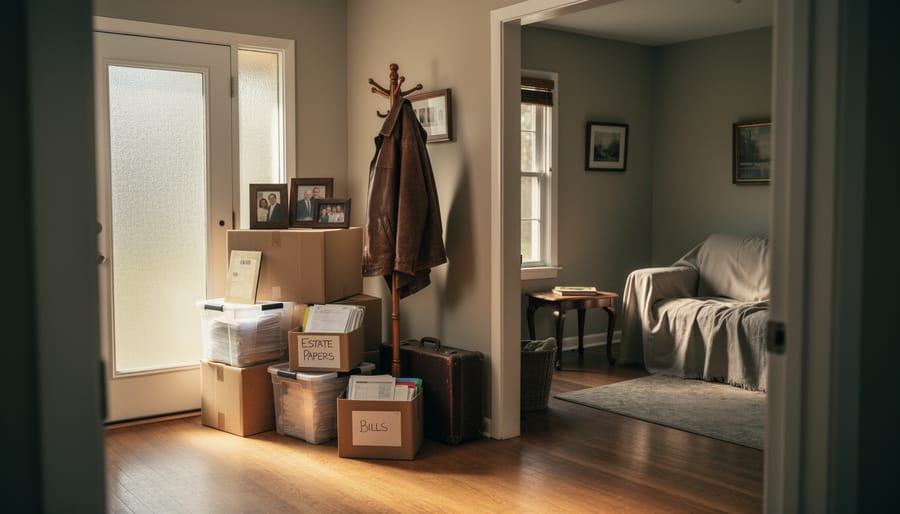
Unequal Stakes: Caregiving, Residence, and Financial Contributions
The sibling who stayed close to a dying parent often carries a different ledger from those who moved away. One may have driven to appointments for years, handled meals and medication, or given up paid work. Another may have lived in the house rent-free, or quietly paid the roof repairs and property taxes. To that sibling, the inherited home can feel like overdue recognition rather than a windfall. The others, meanwhile, frequently hold to a simple principle: the parent had several children, so the estate should be divided equally.
Neither view is unreasonable, and that is precisely the difficulty. Law and sentiment answer the question differently. In most settings the legal default is equal shares among children, and uncompensated caregiving does not automatically earn a larger portion. Courts and notaries tend to look for documentation, such as receipts for upkeep, written agreements, or a clear testamentary intention, before adjusting shares. Without such records, contributions that were real but informal become matters of memory, and memory is notoriously partisan.
Resentment hardens when contributions were never discussed during the parent’s lifetime. Each sibling then audits the other’s sacrifice, and the disagreement shifts from money to fairness itself.
Emotional Value, Family Roles, and Old Grievances
A family home is rarely just a building. For many heirs it holds the kitchen table where homework was done, the garden a parent tended for decades, the room in which a mother or father died. Scholars of kinship and material culture have long observed that houses become repositories of memory, so that selling or dividing one can feel like dividing the parent’s presence itself. That symbolic weight helps explain why a dispute over a sale price can escalate into something far larger.
At succession, the question often shifts from “what is the house worth?” to “what did our parents think of each of us?” A will that leaves the house to one child, or an informal promise that the home would “stay with” a particular sibling, is easily read as a verdict on love rather than a logistical choice. Where a parent gave one child a deposit, a loan, or years of babysitting, the others may remember it as favouritism, while the recipient remembers it quite differently.
Birth order and old roles tend to reappear under pressure. The eldest may assume authority as unofficial organiser, the youngest may be treated as still needing protection, and a middle child may feel overlooked once again. Decades-old rivalries, rarely discussed, resurface in disagreements about who holds the keys, who clears the attic, and whose version of the past counts.
Ambiguity, Poor Communication, and Cultural Expectations
Disputes often begin long before anyone sorts through a parent’s papers. A will drafted decades earlier may name a house that was later sold, refer to “my children” without addressing a stepchild, or leave the property to several siblings with no instruction on who may occupy it or who decides when to sell. Where no will or broader estate plan exists, heirs are left to reconstruct their parent’s wishes from memory, and each sibling’s recollection tends to favour their own interests.
Poor communication compounds the problem. Siblings rarely discuss what a house is worth until the estate is open, and by then one may rely on a municipal assessment, another on an agent’s casual estimate, and a third on the price a neighbour’s house fetched. Without a shared, independent valuation, every offer to buy out a sibling looks like either a bargain or an insult.
Cultural expectations shape these reactions as well. French law treats equality among children as a baseline through the réserve héréditaire, so many French families assume a strictly equal division and see departures from it as a breach of fairness. Canadian common-law provinces give testators wide freedom, so unequal bequests are legally possible and sometimes unsettling to heirs who expected parity. In both countries, the wish to keep a family home within the family can clash with a sibling’s practical need for cash.
Who Has a Claim: Eligibility and Standing Among Heirs
Eligibility starts with who the law, or the deceased, recognises as an heir. Named beneficiaries under a valid will come first in most cases. Where there is no will, or the will fails, intestacy rules decide, and these usually favour a spouse and children, then more distant relatives. A sibling who assumes a share is guaranteed may simply be wrong about the rules in force.
Partners and step-relations deserve particular attention. In common-law provinces, a spouse often holds statutory rights that override a will, and a dependant can bring a claim for adequate support. Step-children generally inherit only if named, while half-siblings usually share on intestacy as though they were full siblings. In Quebec, a married or civilly united spouse is protected, but a de facto partner has no automatic succession rights, a gap that surprises many families.
France takes a different starting point. The réserve héréditaire guarantees children a protected portion of the estate, so a parent cannot disinherit them freely. Canada’s common-law provinces, by contrast, allow wide testamentary freedom, tempered by support claims. Reading these differences through the lens of social science research on kinship helps explain why the same family dispute feels so different on either side of the Atlantic, and why cultural expectations about equality among children shape how siblings interpret fairness.
| Jurisdiction | Testamentary freedom | Protected heirs | Default co-ownership and authority |
|---|---|---|---|
| Common-law Canada | Broad, limited by support claims | Spouses and dependants via statute | Co-ownership; estate trustee, court if contested |
| Quebec | Broad, with spousal protections | Married or united spouses; support claims | Indivision; liquidator and notary |
| France | Limited by reserved shares | Children (réserve héréditaire) | Indivision; notaire, then tribunal |
Standing to challenge follows the same logic. A sibling can usually contest a will on grounds such as lack of capacity, undue influence, improper execution, or fraud. In France, a child whose reserved share was infringed may bring an action en réduction. In common-law provinces, a dependant may seek variation of the estate. Dividing the estate can also be challenged where valuation or procedure was flawed. For bilingual and cross-border families, building cross-cultural understanding early can prevent a legal question from hardening into a family rupture.

How to Settle the Dispute: A Step-by-Step Process for Completing the Settlement

Settlement Routes Compared: Buyout, Sale, Shared Ownership, Mediation, and Court Partition
Most families do not choose a settlement route once and stick with it. They try the gentlest option first and escalate only when talks stall. The routes below run roughly from least to most adversarial, and the right fit depends less on the property than on how the siblings communicate.
| Route | How it works | Best suited to | Cost and time | Risk to relationships |
|---|---|---|---|---|
| Buyout | One sibling pays the others their share, usually after an independent appraisal | One heir wants to keep the home and can finance it | Appraisal, legal and financing costs; often a few months | Low if valuation is trusted, high if it is contested |
| Sale | The house is sold and proceeds are divided according to each share | No one wants or can afford the property | Agent and legal fees; market-dependent | Moderate; disputes shift to price and timing |
| Shared ownership | Siblings keep the house together under a written agreement | Strong trust and a shared purpose, such as a family cottage | Low upfront; ongoing upkeep costs | Can postpone conflict rather than resolve it |
| Mediation | A neutral third party helps siblings reach their own agreement | Communication has broken down but goodwill remains | Usually far cheaper than litigation; weeks to months | Lowest; outcomes are voluntary |
| Court partition | A judge orders a sale or division when siblings cannot agree | One heir refuses to cooperate or negotiate | Highest legal fees; often a year or more | Highest; positions tend to harden |
Buyouts and sales are the most common endpoints, but they rarely work without a neutral valuation. An appraisal commissioned jointly removes the suspicion that one sibling is lowballing another. Mediation often sits underneath either route, helping siblings agree on the terms before money changes hands.
Shared ownership deserves caution. It suits siblings who already coordinate well, but it demands a written agreement covering who pays what, who may occupy the property, and how any one owner can exit. Without that, it simply recreates the original disagreement on a slower clock.
Court partition should be treated as a last resort. It is effective at ending a stalemate, yet it is slow, public, and expensive, and the judge, not the family, decides the outcome. In France, the equivalent step is a judicial partage when notarial settlement fails.
Before committing to any route, weigh the cost considerations alongside the emotional ones, since a cheaper route that fractures the family may prove costlier in the end.
Valuation, Taxes, and Documents Needed Before Any Agreement
An independent appraisal is the foundation of any fair agreement, because siblings who rely on their own estimates rarely agree. A neutral valuation, ideally dated close to the date of death, gives a shared reference point for a buyout, a sale or a partition.
Tax rules then shape what each heir actually receives. In Canada, the deceased is generally treated as having disposed of property at fair market value on death, so a capital gain may arise unless the principal-residence exemption applies. A later sale by the heirs can trigger a further gain measured from that stepped-up value. In France, inheritance duties (droits de succession) apply per heir after allowances, and children benefit from a substantial per-parent allowance, though the rate and exemptions depend on the relationship and on the estate’s overall value. Because the rules differ so much, a tax adviser or notary should confirm the figures before anyone signs.
Before negotiating, assemble the records that support both valuation and tax treatment:
- The will, or proof of intestacy if none exists.
- The death certificate.
- The title deed or land registry extract.
- Current mortgage statements and any other charges on the property.
- A recent independent appraisal.
- The deceased’s tax filings and property tax bills.
- Receipts for repairs and improvements.
- Records of caregiving costs and contributions to upkeep.
Having these on the table early reduces suspicion, since every sibling can check the same facts.
Case Studies: How Real Families Resolved House Disputes in Canada and France
Case studies help show how abstract rules play out between real siblings. Because anonymised family files are rarely public, the three accounts below are labelled illustrative composites, built to reflect patterns reported in academic sources on succession and in published partition decisions.
The first composite involves a buyout after mediation in an Ontario-style common-law setting. A mother leaves her house equally to three adult children. The youngest lived there and cared for her for six years, and she wants to stay. The others expect equal shares. Early messages turn bitter, because the caregiver feels her labour has been erased. A mediator proposes an independent appraisal and a credit for documented upkeep, and the youngest sibling refinances to buy out the others. The law supplied the equal shares, but the settlement worked because it acknowledged the emotional claim that the will ignored.
The second composite follows a forced sale. Two brothers inherit a house under a will, and one occupies it rent-free while refusing to pay taxes or accept a valuation. After months of stalemate, the other applies to a court for partition and sale. Courts in common-law provinces generally order a sale where co-owners cannot agree, since co-ownership is not meant to be permanent, and the house is sold on the open market. The outcome is efficient but costly, and the relationship does not recover. Legal fees and delay reduce what each brother receives.
The third composite is French. Three siblings fall into automatic indivision on their father’s death. One lives abroad and wants cash, while another wants to keep the family home. Nothing moves for two years, and carrying costs accumulate. They then retain a notaire, who has the property valued, calculates each child’s réserve héréditaire share, and drafts a partage in which one sibling takes the house and pays an équitable compensation, the soulte, to the others. Here the statutory framework did much of the work, because the notary’s role forces the parties to put numbers on their grievances.
Read together, the cases show a pattern. Settlements tend to succeed when the legal route is matched to the emotional driver, whether that is recognition, control, or simple exit.
For wider comparative reading, see the Canada, France context on how the two societies approach shared institutions.
Rights and Obligations of Co-Heirs While the House Remains Unsettled
Until the house is sold, bought out, or formally partitioned, each sibling holds a share of something that none of them fully controls. In common-law provinces, heirs usually hold the property through the estate, and the executor (estate trustee) has legal authority over it. In Quebec, the liquidator plays that role. These fiduciaries must preserve the asset, keep it insured, pay debts and taxes, and account to the beneficiaries. Failing at those duties can create personal liability.
In France, the heirs hold the house in indivision, and the notaire’s file frames the practical rules. Ordinary management decisions require a two-thirds majority by share, while sale or major changes generally require unanimity unless a court authorises otherwise. A co-heir who occupies the home exclusively may owe an indemnité d’occupation to the others.
Rights and duties tend to run in parallel:
- Right to information: every heir may request estate documents, valuations, and financial records, and heirs must share what they know in good faith.
- Right to an accounting: heirs may demand a clear record of income, expenses, and any rent collected, and heirs who manage the property must provide it.
- Right to seek partition: no one can be forced to stay in co-ownership indefinitely, and in France an heir may petition a court to end indivision after the notarial route fails.
- Right to challenge: heirs may contest a will, a valuation, or an administrator’s conduct, and must act within the applicable deadline.
- Duty to carry costs: each heir typically bears a proportionate share of property tax, insurance, utilities, and necessary repairs.
- Duty to respect decision-making rules: no sibling may sell, lease, or change the locks unilaterally.
Delay carries real costs. Property taxes, insurance, and maintenance accumulate monthly, and an empty house can deteriorate quickly or lose insurance coverage. Limitation periods also run: will challenges and claims against an estate must be brought within fixed windows that vary by province and by French law. Siblings who contribute more than their share may later seek reimbursement, but only if they have kept careful records. Written agreements about interim use and cost-sharing, even informal ones, often prevent the conflicts that formal proceedings would otherwise have to resolve.
Where to Get Help: Mediators, Notaries, Courts, and Support Services
Families rarely need to solve an inherited-house dispute alone, and the right first call depends on where the property sits and what kind of help is needed.
- Ontario, British Columbia and other common-law provinces: provincial law societies run lawyer-referral services and confirm that a lawyer is licensed.
- Quebec: the Chambre des notaires du Québec and the Barreau du Québec help families find a notary or lawyer for liquidation and partition.
- Canadian mediation bodies: ADR Institute of Canada affiliates and provincial family mediation associations list accredited estate and family mediators.
- France: the Conseil supérieur du notariat connects heirs with a local notaire, who handles the partage.
- French mediation: médiateurs listed by the court of appeal or the Centre de médiation et d’arbitrage de Paris can help before litigation.
- Legal aid: provincial legal aid plans in Canada and aide juridictionnelle in France may cover low-income heirs.
Court registries and the greffe offer procedural guidance, such as how to file a partition application or a petition to the tribunal judiciaire. They cannot give legal advice, though, so treat them as a source of forms and deadlines rather than strategy.
Cross-border and bilingual families face added friction. A Quebec heir may need a French-language document translated for a French notaire, and an Ontario sibling may need an English summary of a notarial deed. Certified translation, and where possible a professional who works in both languages, reduces costly misunderstandings. Strong bilingual communication also matters in mediation, where tone and nuance can shape whether siblings agree.
When the house is in one country and the siblings are split between the two, the law of the property’s location generally governs the immovable, while succession rules for movable assets can differ. Ask early whether a lawyer in one jurisdiction can coordinate with a notary in the other. A single initial consultation that maps which law applies to which asset often prevents duplicated proceedings and saves months of delay.
How to Apply or Complete the Process
Completing a settlement follows a broadly similar order in both countries, though the professional who guides it differs. Treat the steps below as a general sequence, and confirm the specifics with the estate lawyer, notary, or court registry handling your file.
1. Confirm the legal basis. Locate the will, or establish that the estate passes on intestacy, and identify every heir entitled to take part.
2. Appoint or confirm the person in charge. In common-law provinces this is the estate trustee, who may need a grant of probate. In Quebec the liquidator acts, and in France the notaire opens the succession.
3. Gather documents. Assemble the death certificate, title or deed, mortgage statements, tax records, and proof of any debts.
4. Obtain an independent valuation so every sibling works from the same figure.
5. Settle debts, taxes, and duties from the estate before distributing anything.
6. Choose a resolution route: buyout, sale, continued shared ownership, mediation, or, as a last resort, court partition.
7. Formalise the outcome. A notarial deed of partage in France, a signed agreement with a registered transfer in Canada, or a court order each completes the process.
Keep copies of every signed document and filing receipt.

Frequently Asked Questions About Sibling Disputes Over an Inherited House
Can one sibling force a sale of an inherited house?
Usually, yes, though not instantly. In most Canadian provinces a co-owner can apply to court for partition and sale if the others will not agree, and in France no one can be compelled to remain in indivision, so a co-heir can seek a notarial partage or, failing agreement, a judicial one. Courts and notaires generally prefer a negotiated outcome first, so expect mediation or a formal demand before litigation.
What if a sibling refuses to leave the house or pay their share of the costs?
An occupying heir can often be asked to pay rent or an occupation indemnity to the others, and co-owners who cover taxes, insurance, and repairs can generally claim reimbursement when the estate is settled. These remedies differ between common-law provinces, Quebec, and France, so a lawyer or notaire should confirm the route and any time limits.
Can a will be challenged, and how are unequal contributions handled?
A will can be contested on grounds such as lack of capacity, undue influence, or improper execution, and in France a child’s réserve héréditaire limits how far a parent can favour one heir. Caregiving or upkeep contributions are not automatically rewarded; they are typically recognised through agreement, a claim against the estate, or a court’s discretion where the law allows it. Evidence such as receipts and records matters more than recollection.
What if the siblings live in different countries?
Generally the law of the place where the property sits governs how the house is transferred, while the deceased’s residence and nationality can affect the succession as a whole. Cross-border families should consult a professional in each jurisdiction, and may find remote mediation more practical than court.
None of these answers replaces tailored advice. Outcomes depend on the province or country involved, the wording of the will, and the family’s circumstances, so use these responses as a guide to the questions worth asking rather than as a prediction of the result.
Disputes over an inherited house rarely turn on a single cause. They arise where three forces meet: the emotional meaning of a parental home, the unequal financial stakes of those who cared for, lived in, or maintained it, and legal frameworks that leave real room for ambiguity. When any one of these is left unaddressed, the others tend to harden.
The most consistent lesson from both jurisdictions is that early action matters. Open communication before positions calcify, an independent valuation that gives everyone the same numbers, and structured mediation guided by a lawyer or notary most often preserve both the property and the relationships around it. Court-ordered partition remains available, but it is typically slower, costlier, and harder on family ties.
Comparing Canadian common law and Quebec civil law with France’s reserved shares and indivision regime shows that the same family tensions can be channelled through very different procedures. Readers with a personal or scholarly stake are encouraged to consult the cited statutes and studies, and a bilingual summary in French follows for those who prefer it.